Over more than 130 years, 150 West Market Street in the heart of Downtown Salisbury has been a wholesale grocery warehouse, an early car showroom, one of the region’s largest furniture stores, and an antique shop. Today, fully restored and rebranded as Riverview Commons, it’s home to a roster of thriving businesses.
The Fire of 1886
To understand the building, you have to start with the fire.
On the evening of Monday, October 18, 1886, a blaze broke out in a livery stable on Dock Street, now West Main Street, owned by Frank S. Toadvine. Southeasterly winds pushed the flames across roughly 22 acres of downtown, from the Camden Bridge to North Division Street. The city’s lone fire engine, neglected since 1879, was in such poor shape that water wouldn’t pass through it, and crews from Wilmington, Pocomoke City, and Crisfield had to load their equipment onto trains just to reach the scene. The fire burned for 17 hours. When it was over, 128 buildings were gone: stores, homes, hotels, churches, an opera house, the post office, and a bank among them. Only the Wicomico County Courthouse survived.
Fortunately, no lives were lost in the fire, and many people were able to retrieve belongings before the flames reached their homes and businesses. These belongings were carried to the Wicomico County Courthouse for safekeeping, the only building in the area made of brick – and expected to survive. As devastating as it was, the Great Fire of 1886 reshaped the city. Salisbury rebuilt in fire-resistant brick and stone and widened its streets, and local historian Richard Cooper later described the disaster as the moment of Salisbury’s “transition from country town to modern city.”
L. Gillis & Son: A Grocery Empire on the River
In May 1890, Frank Toadvine sold the Dock Street land, the very property tied to the fire’s origin, to Allison A. Gillis for $4,250. There, the Gillis family (Allison’s father was Beauchamp Lukard Gillis, known throughout the region as B. L. Gillis) raised a two-story brick warehouse with a handsome Victorian storefront: large glass display windows, raised brick segmental arches, and an ornamental iron cresting that spelled out the firm’s name. A gasoline-powered elevator, tucked into a small structure on the building’s south side, carried goods between floors. The building fronted Dock Street and ran all the way back to the Wicomico River.
It became the home of B. L. Gillis & Son, wholesale grocers, a business established back in 1866 and recognized as the first wholesale grocery on Delmarva. At its height it was described as one of the largest wholesale grocery houses in the South and the largest handler of grain and feed on the Peninsula.
When Allison Gillis died in 1913, the building passed to his two daughters, Edna Gillis Tull and Mamie Gillis Grier, who held it until 1923. (For a stretch, the space led a double life: a 1916 Sanborn insurance map shows the Peninsula Motor Company operating a 40-car showroom inside.)
The Feldman’s Era
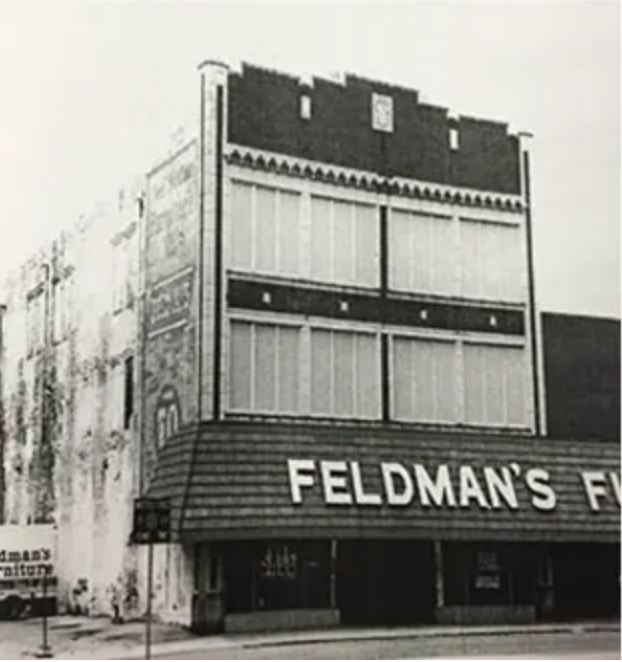
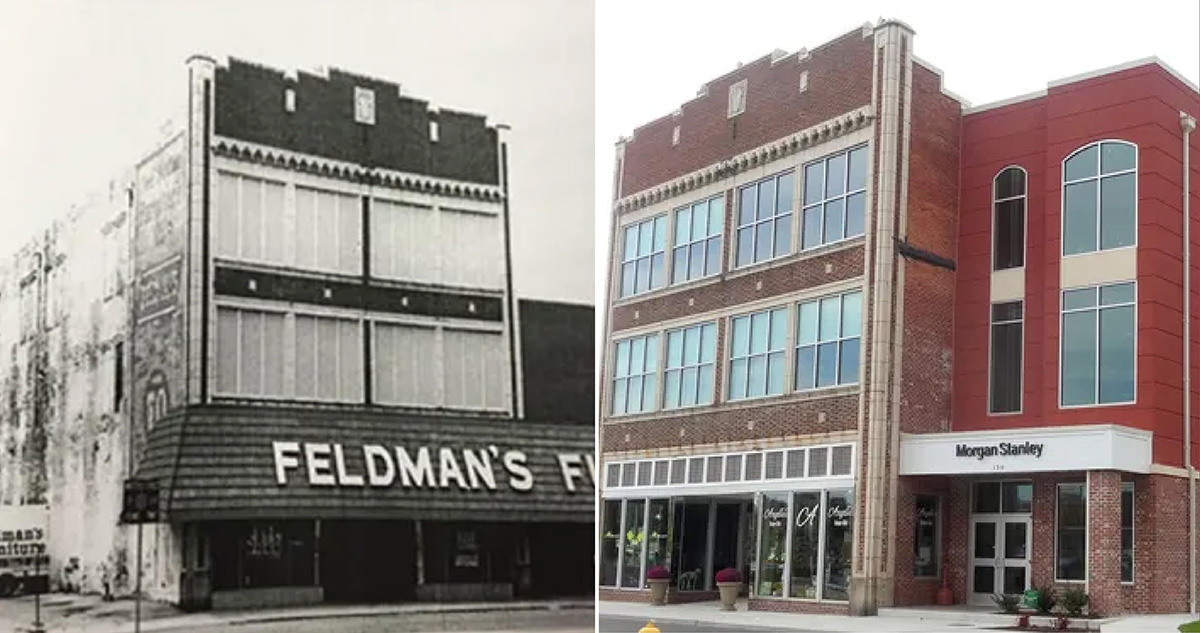
In 1923, the property transferred to brothers Samuel S. and William Feldman. The following year, the building was raised to three stories and dramatically restyled in the Tudor Revival fashion: Flemish bond brickwork, limestone corners, terra-cotta and plaster detailing, and decorative medallions crowned by a carved coat of arms and shield that still anchor the facade today.
The transformed building became the flagship of Feldman Brothers Furniture, a business the family had started in 1904. By the mid-1930s it was one of the largest furniture stores in the region and a genuine downtown Salisbury landmark. Samuel’s grandson, David Miller, joined the business in 1974 and stayed with it until Feldman’s finally closed its doors in 2000. A year later, in 2001, Miller reopened the same space as Market Street Antiques, filling it with furniture, jewelry, musical instruments, toys, glassware, and more.
A Careful, Ground-Up Restoration
Eventually the building fell quiet, and that’s where Gillis Gilkerson comes in.
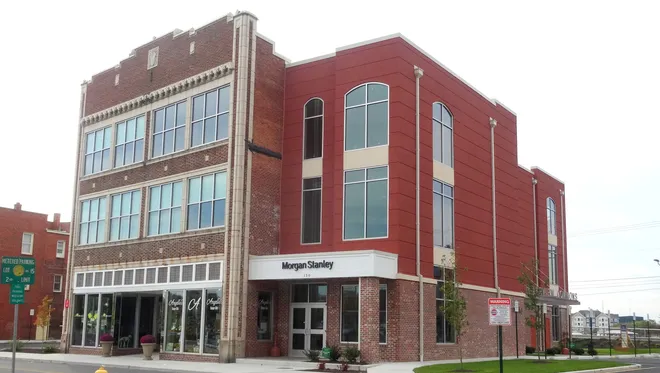
In September 2014, the Salisbury-based construction and development firm began work on a full historic restoration rather than a teardown. The project began by demolishing a roughly 60,000-square-foot portion of the structure while preserving the most historically significant 15,000 square feet for a massive renovation. A structural analysis revealed just how much work lay ahead. The old wood floor couldn’t be salvaged, so the team filled and capped the crawl space with reinforced concrete — raising the floor about a foot and a half in the process to meet current flood regulations. The failing roof was removed and replaced, and brick walls found to be failing mid-construction were rebuilt and reinforced so they could be retained. New stair towers, an elevator, and common areas completed the transformation, yielding roughly 20,000 square feet of multi-use, Class A professional office space.
It was demanding work, but well-trodden ground for Gillis Gilkerson, which had already restored Salisbury’s old Synagogue (300 W. Main Street) in 1983 and the former Woolworth’s building (212 W. Main Street) in 1994.
The firm relocated its own offices into the building in the fall of 2016, eventually settling its headquarters on the second floor, where it remains today.
Photos of the transformation, as well as, historical photos of the building and the Great Salisbury Fire of 1886 are on display in the lobby, for those who are interested in learning more.
Riverview Commons Comes to Life
Renamed Riverview Commons, the restored building drew tenants who wanted a foothold in a revitalizing downtown. Morgan Stanley took the entire third floor, and Gillis Gilkerson settled its headquarters on the second. On the ground floor, NAI Coastal launched its commercial brokerage and has been headquartered in the building ever since, handling its leasing alongside Principal Brad Gillis. Bay Mortgage and Sage Title rounded out the roster.
For Tyler Barnes, President of Gillis Gilkerson, the speed of the lease-up speaks for itself:
” Every time a unit at Riverview Commons has opened up, the NAI Coastal team has filled it in no time. With Sage Title joining as our newest tenant, the building is once again fully occupied, thanks to NAI Coastal’s market knowledge and the work they’ve put into this property.”
For more than 130 years: through fire, reinvention, and revival, 150 West Market Street has remained at the heart of Downtown Salisbury.